

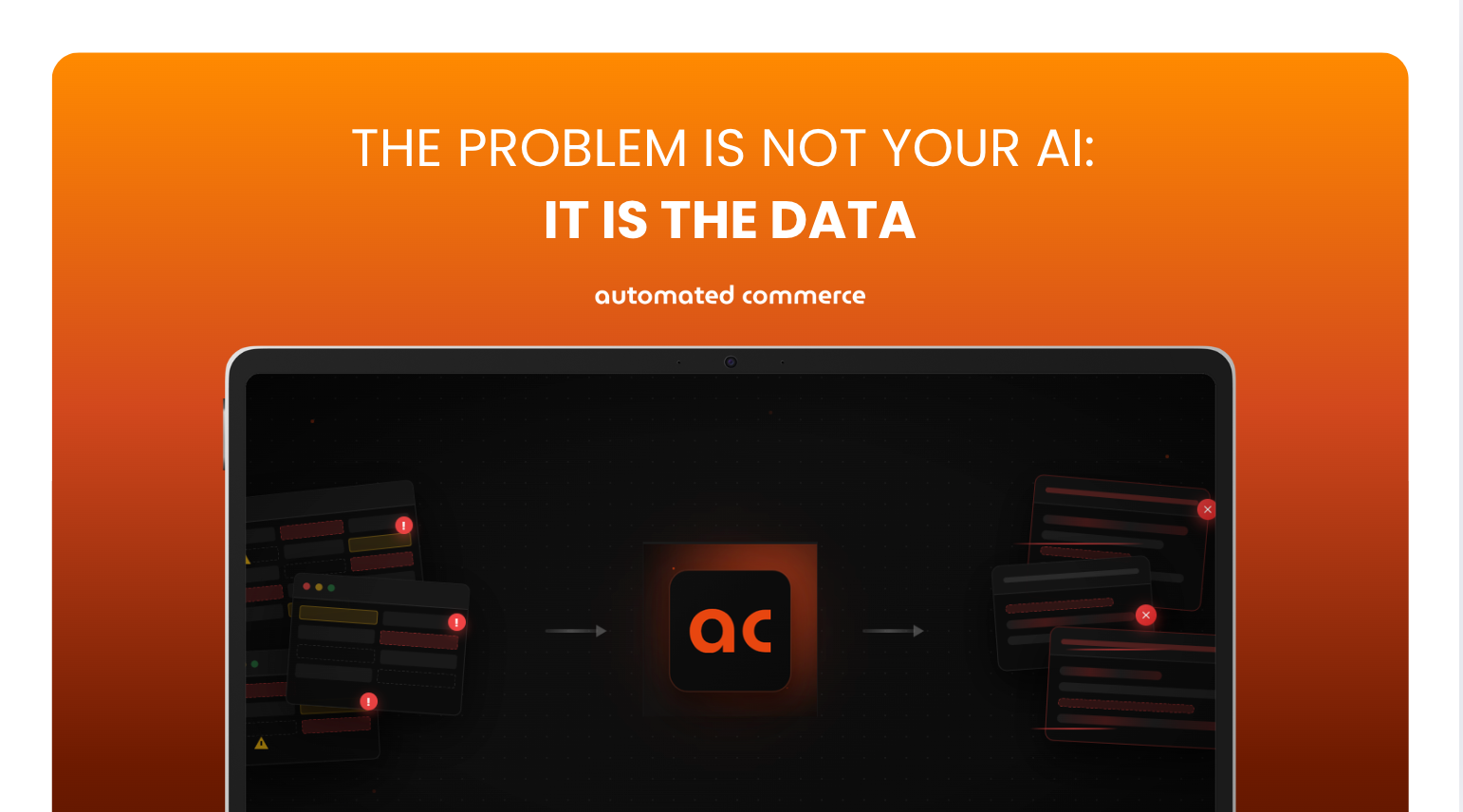

Nearly three-quarters of businesses see potential in AI tools, but only one in five SMB retailers actually use them. The gap between "interesting" and "effective" is huge, and it's caused by a specific problem that gets ignored in almost every discussion about AI: your data isn't ready.
The real bottleneck: not the AI, but what you feed it
Many SMB retailers see AI as a magic bullet. Download the tool, run the program, watch your business transform. Reality is different. An AI model only performs well when it receives context-rich, structured data. Instead, most online stores work with chaotic data collections: inconsistent product descriptions, duplicates, missing attributes, and data scattered across ten different systems.
This isn't a technical detail. Bad data leads to unreliable AI output, and unreliable output leads to managers switching off AI tools. The pattern repeats itself in business after business.
Why data makes the difference
AI models don't learn from your data, they use your data as context to execute tasks. Complex tasks like creating on-brand content can only be done well by AI when structured data provides the right context. Is your data inconsistent, full of gaps, or disconnected from your actual business processes? Then AI lacks the context to deliver good output. A product feed full of duplicates and generic descriptions means your AI produces the same generic output, and then you're worse off than when you started.
What you need is data that meets three criteria: accurate attributes, complete information, and context that's relevant to your specific task. This is far more work than vendors want you to believe.
The three practical problems retailers face
The integration maze. You've got your ERP, your webshop, your marketing tool, your inventory management, all within the same business, but they don't talk to each other. Relevant data for AI is spread across these systems and has to be brought together manually first. That takes time, input errors are inevitable, and you're never certain you have all the information you need.
Task specificity without structure. AI doesn't work on "improve everything." AI works on "execute this specific task based on this data." An AI model for product descriptions isn't the same as a model for price optimisation. You need to prepare data separately for each task, and that's where many retailers get stuck.
Scale without process. Prepare data manually and then deploy an AI tool, and it might look great for ten products. But you have thousands. Without an automated data pipeline, scaling becomes a nightmare and your ROI disappears.
What effective AI implementation really costs
Businesses that use AI successfully don't start with the AI tool. They start with data organisation. That means: standardising product feeds, cleaning up duplicates, filling in missing information, and building workflows that automatically keep this data in order. Only then do you connect AI.
This isn't a one-off job. Effective AI requires ongoing data quality, tracking metrics, and process improvement. Many retailers stop after two weeks because they hadn't factored this in.
How practical data organisation works
For content-related processes in e-commerce, such as product descriptions, alt texts, and content duplicates, this works as follows: you gather all your product data from different sources, standardise attributes, remove duplicates, and organise everything in a central repository. Then you build workflows that regularly check whether your data stays in order. Only then do you deploy AI for specific tasks: rewriting descriptions, generating unique alt texts, personalisation.
This kind of system does two things at once: it organises your data so AI can work with it, and it ensures your AI output delivers tangible results rather than theoretical value.
Automated Commerce: data and automation in one system
This is where Automated Commerce comes in. It builds exactly this data organisation layer, focused on content and product data for online retailers. Automated Commerce ensures your product data stays standardised, clean, and up-to-date, and only then runs AI workflows. The result: AI tools that actually deliver quality work instead of producing rubbish at scale.
The likely state of your data right now
Many retailers don't actively check their data quality. They know it's a struggle, but they don't measure it. An honest question: how complete are your product attributes really? How many duplicates do you have in your descriptions? How much data is still sitting in emails and spreadsheets instead of in your systems? That insight is the first step towards AI implementation that actually works.