


What is a-commerce, and why is it growing so fast?
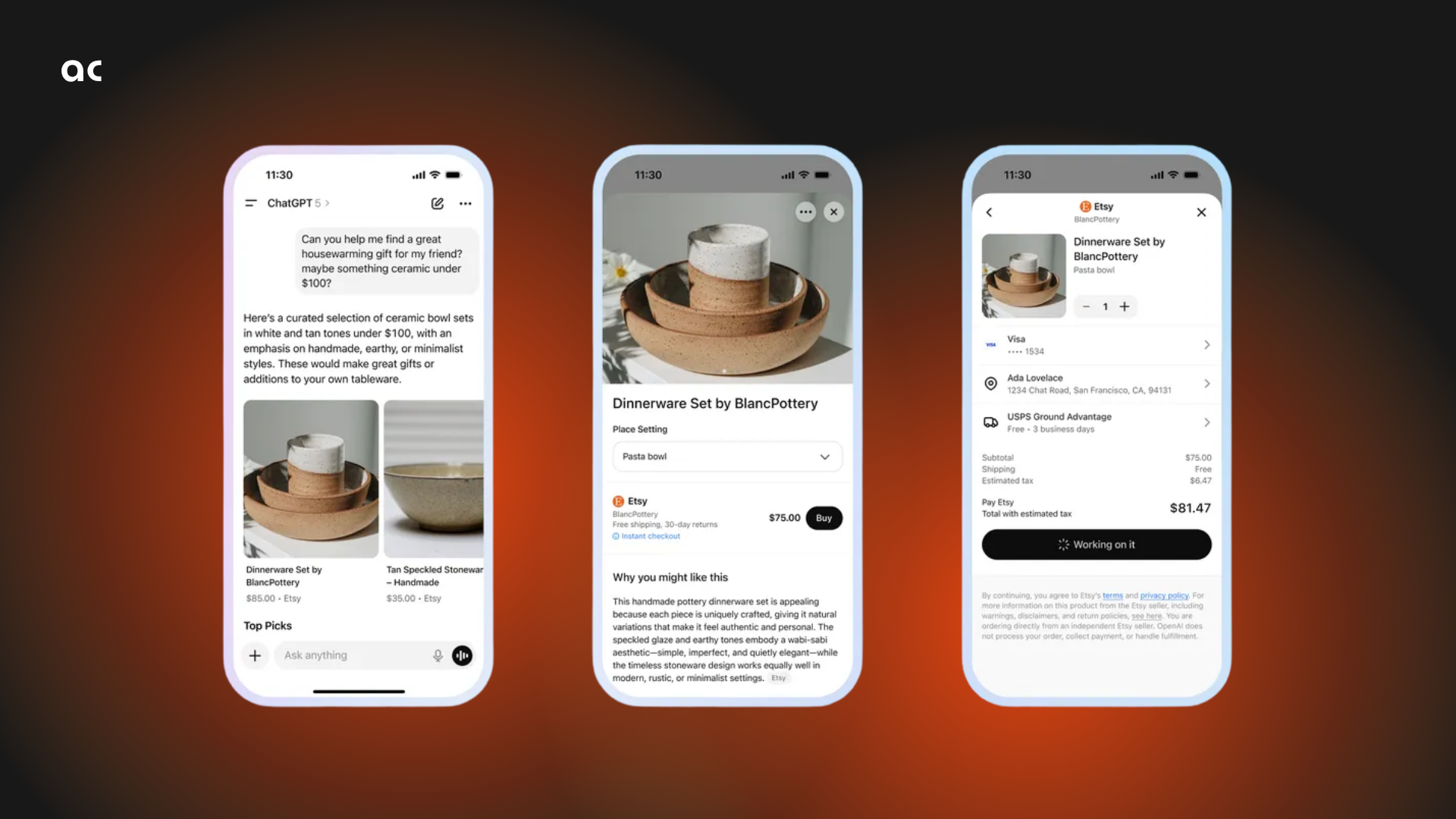
Consumers are shopping via AI, including ChatGPT: "find a dark blue dining chair under €400, delivered within a week." The AI searches, compares prices, checks stock across different webshops, and presents a shortlist or completes the purchase directly. The customer never visits your webshop. This is a-commerce, also known as agentic commerce: AI that handles the entire purchasing process on behalf of the consumer.
It sounds like the future, but it is already reality. ChatGPT opened this channel in 2025. Google followed in January 2026 with its own protocol, backed by Shopify, Walmart, Visa and Mastercard. Adobe Analytics recorded a 4,700% growth in traffic from generative AI to webshops in one year. The channel is still small but conversion is remarkably high: according to Q1 2026 data, agentic traffic converts at 15 to 30%, compared to an average of 2 to 3% for traditional e-commerce (source: dev.to / ACP analysis). Those who lay the foundation now are building a lead that will be nearly impossible to close later.
How does an AI decide which product to recommend?
This is the core of what most retailers still don't understand. An AI agent doesn't visit your webshop the way a human does. It doesn't read beautiful product pages, look at lifestyle photos, or get convinced by brand feeling or design. An AI agent reads data. Structured, machine-readable product information: exact dimensions, materials, colour variants, category, price, availability.
The AI matches the user's search query with the data available in your product fields. If someone searches for a "waterproof hiking jacket for men in black, size L", the AI looks for products where all these attributes are explicitly recorded in descriptions, metafields or structured data. If your jacket only says "premium outdoor jacket, timeless design", the AI finds no match and you don't appear in the results. Not because your product isn't good, but because the data doesn't give the AI enough confidence to make a reliable recommendation.
The problem most retailers are facing right now
The reality is that the product data of most webshops was never built for AI. It was built for humans. Supplier data arrives as Excel sheets, PDF datasheets or loose emails: inconsistent in format, full of gaps, and rarely complete enough for the standard that AI shopping agents maintain.
A product without an EAN code, without correct categorisation, or with a generic title disappears from the view of every AI agent searching on behalf of a customer. Think of a customer asking for "an oak coffee table, maximum 120 cm wide, suitable for a small living room." If your product hasn't explicitly recorded those attributes in the right fields, the AI sees no match — even though the answer is buried somewhere in a product description that's perfectly readable for humans. Gartner predicts that by 2030, 20% of all e-commerce transactions will be handled via AI platforms. Retailers who have their product data in order now will be recommended by default. Retailers who wait will pay the price of invisibility in the channel where their customers have already gone.
How Automated Commerce makes you a-ready
This is exactly the problem Automated Commerce solves, and it's the reason why structured product data is central to everything we build. Auto Mate, our agentic AI, processes raw supplier data in any format and automatically transforms it into structured, complete product information: correct titles, standardised attributes, SEO-optimised descriptions and category taxonomy at the level that AI shopping agents understand.
Unstructured supplier data is converted into machine-readable product data that is published directly to your Shopify store. This makes your catalogue not only more findable via Google, but also ready for indexing by ChatGPT, Google AI Mode, Perplexity, and all AI shopping channels that will follow in the coming years. You don't need to be a developer, hire a data architect, or wait months. The workflow is designed so you can start today.
Early stage: The advantage of starting and the cost of falling behind
A-commerce is still in its early stage. Most retailers haven't put this channel on their radar yet, and that's understandable. It's still largely playing out in the United States.
But that's also exactly the situation you recognise from earlier shifts. When retailers in the early 2000s were deciding whether they needed a webshop, it seemed far away for many. Those who stepped in early built years of advantage in online visibility that new entrants could never match. The same was true for mobile optimisation, for Google Shopping, for marketplaces as a sales channel.
A-commerce follows that line. The channel is small now. The infrastructure is being laid by the major platforms. Europe typically follows the US by 12 to 24 months. That means retailers now have exactly the time to get their product data in order — without time pressure, without panic, just as part of a healthy e-commerce operation.